Dental Implants

If you are disturbed about a missing tooth, dentures that are uncomfortable or simply don't like the idea of having a nearby healthy tooth chipped to make a  bridge , talk to our specialists to see if dental implants can help  you. 

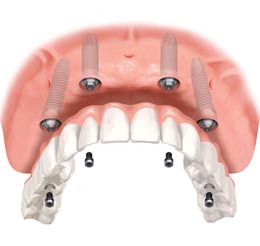
Dental implants are a popular and effective way to replace missing teeth and are designed to blend in with the rest of your teeth. They are an excellent long-term option for restoring your confidence and smile. Dental implants are constructed using titanium that is compatible with the human body. They are titanium posts that are surgically placed in the upper or lower jaw. The jawbone fuses with the titanium surface providing a strong anchorage for the dental prosthesis constructed over it. To receive an implant, you need to have healthy gums and enough bone to support the implant. 

Traditionally the replacement of missing teeth was handled with bridges or partial dentures. This process does not stop the bone loss in the area of the missing teeth and so this is deemed a short term solution. With implants, the chewing impact goes right to the jaw bone and thereby halt bone loss. Dental implants have now become the standard of tooth replacement care.
The main feature of an implant is that the roots of the missing tooth are replaced by supportive posts. Titanium is the most bio-compatible material available today, and it fuses with the jaw bone in 3 to 6 months.

Stages of Implant

Implant is carried out in 3 stages.

  1. 1) Planning the treatment.
  2. 2) Fixing the titanium root.
  3. 3) Crowning the root.

The first crown will be a temporary one. This crown will be replaced by the permanent crown usually after 3 to 6 months.

Maintenance

Proper dental hygiene is essential for the long-term success of your implant. Specific instruction by your dentist must be followed for brushing and flossing the area. A regular check-up is also ideal. Proper care to implants will ensure a lifetime of satisfaction.

Types of Dental Implants.

  • Endosteal: This is the most commonly used implant. These include screws, cylinders or blades which are surgically placed into the jaw bone. Each may hold one or more prosthetic teeth. This type of implant is ideal for people with bridges or removable dentures.
  • Subperiosteal: These are implants used on people who are unable to wear conventional dentures and who have minimal bone height.

Who can accept dental implants?

A good general and oral health is required for the recipient. Adequate bone density in the jaw is needed to support the implant. The gum tissues need to be free of periodontal disease.

Implant techniques

  • Single tooth implant – one implant and a crown can replace it.
  • Several teeth implant – in the case of replacing several teeth, implant supported bridges can replace them.
  • All teeth – an implant supported full bridge or full denture will be required.
  • Sinus Augmentation – the upper jaw implants are usually harder due to insufficient bone quantity and its close proximity to the sinus. Sinus augmentation raises the sinus floor by developing bone for the placement of dental implants.
  • Ridge modification – Deformities in the upper or lower jaw can leave inadequate bone in which to place implants. In such cases the gum is lifted from the ridge to expose the bone defect. Here bone is filled with bone or bone substitute to build up the ridge.
26+
Years Experience
100%
Personalized Care
50+
Treatments

More specialised treatments

Implants Outlook
 Dental Implants developed over the past 30 years are a revolutionary technique for effective r...
Benefits of Dental Implants
With dental implants, mouth is restored to its natural state. With implants the entire tooth includi...
Types of Dental Implants
Mainly there are 2 types of implant procedures 1. Single piece immediate loading dental implant...
Single Tooth Implant
For people who are missing one or more teeth, Single-tooth implants are ideal. The dentist makes an...
Multiple Dental Tooth Implant
This is ideal when replacing several gaps of teeth. If the missing gaps are clustered, implants with...
Implant supported denture
An implant-supported denture is an over denture that is supported by and attached to implants. This...
Full Mouth Implants
In single tooth implants, the implant is placed into your bone supporting a single crown. If you are...
Full Mouth Implants
In single tooth implants, the implant is placed into your bone supporting a single crown. If you are...
Sinus Lift
If bone needs to be added to the upper jaw or in the area of premolars and molars, a sinus lift is r...
Bone Grafting
Bone grafts are used to build up or fill in jawbone defects allowing the successful placement of imp...
Our Services

Family Dentistry

Routine care for all ages

Cosmetic Dentistry

Smile makeovers & veneers

Dental Implants

Permanent tooth replacement

Implants Outlook

Comprehensive planning

Benefits of Implants

Durability & comfort

Types of Implants

Single, multiple, full‑arch

Solutions for
Unattractive Smile Discolored / Stained Teeth Facial Deformities Missing Tooth Gummy Smiles Tooth Ache Gum Disease
Comprehensive Care

Dental Implants

Popular, effective technique. Two‑step procedure with titanium fixture. No shaving of adjacent teeth.

Dentures

Full or partial dentures, custom‑made. Ideal when implants are not practical.

Gum Disease

Specialized treatments for gingivitis and periodontitis. Healthy gums support overall health.

Porcelain & Veneers

Porcelain on‑lays, veneers, laminates — strong, natural color, repair fractures.

Preventive Dentistry

Awareness and tools to avoid future problems. Prevention is the best treatment.

Reconstructive

Customized solutions: crowns, bridges, implant surgery, and removable restorations.

Root Canals

When decay reaches the pulp, we remove and seal with minimal pain using advanced anesthesia.

“Every smile is unique. Our approach is a customized solution rather than a general solution, because we believe that in dentistry each person’s requirement needs to be viewed differently.”